Meet Our Attorneys

Dr. Richard Lindsay
Dr. Richard Lindsay is a highly accomplished attorney with a unique and invaluable background in medicine and law. He was raised and educated in West Virginia and obtained his medical and legal education from WVU. He spent over 25 years as a practicing emergency room physician before retiring from medicine to focus his efforts solely on protecting injured victims and their families.
Beyond his exceptional academic achievements, Dr. Richard has extensive practical experience in the medical and legal fields. His medical background enables him to evaluate complex medical records, interpret diagnostic tests, and comprehend the intricate details of medical procedures and appropriate care. This in-depth understanding allows Dr. Richard to identify instances of negligence effectively and construct compelling arguments on behalf of his clients.
Throughout his legal career, Dr. Richard has successfully represented numerous clients in complex medical malpractice and personal injury cases, securing substantial compensation for their injuries. With over 40 years of courtroom experience and numerous plaintiffs’ verdicts, Dr. Richard does not shy away from complex cases. He has the medical expertise to identify the area of negligence and the ability to explain the issue to you, your family, and the jury. Dr. Richard is a fierce client advocate, respected by the bench and the bar.
With Dr. Richard as your legal advocate, you can rest assured that you will receive incomparable representation rooted in a profound understanding of medicine and the law. His unwavering dedication to his clients and exceptional qualifications make him the pre-eminent advocate for those seeking justice in medical malpractice and personal injury.

Dr. Pamela Tabor Lindsay
Dr. Pamela Lindsay is the founder and owner of Tabor Lindsay & Associates. She is an accomplished attorney with a unique medical, public health, and health sciences background. Dr. Lindsay is a registered professional nurse (RN) and a medical doctor (MD) with a master’s in public health (MPH) and a doctorate in health science (DHs). With such a rare combination of legal expertise and extensive medical knowledge, Dr. Lindsay brings unparalleled understanding and advocacy to her clients in medical malpractice and personal injury cases.
She is deeply committed to providing compassionate and empathetic representation to injured clients. Recognizing the physical, emotional, and financial toll that medical negligence can have on individuals and their families, Dr. Pam approaches each case with unwavering dedication and a genuine concern for the client’s well-being.
With her extensive medical background, Dr. Pam has first-hand experience caring for patients and, as a lawyer, witnessing the impact of medical negligence on a client’s life.
This unique perspective fosters a deep empathy, allowing her to connect with her clients personally and truly understand their challenges. She recognizes that injured clients often require emotional support and guidance during the complex process of seeking justice. This compassionate approach is evident in her personalized and attentive client service by listening to her client’s stories, concerns, and fears in a safe and supportive environment.
Dr. Pam is deeply committed to making a positive impact on the lives of her clients. Her personal approach, combined with her exceptional qualifications, sets her apart as a trusted advocate for injured individuals and their families seeking justice.
With Dr. Pam by your side, you can be confident that you will receive outstanding representation and the support and understanding you deserve during this challenging time.
MEET
Dr. Pamela Tabor Lindsay
Dr. Pamela Lindsay is the founder and owner of Tabor Lindsay & Associates. She is an accomplished attorney with a unique medical, public health, and health sciences background. Dr. Lindsay is a registered professional nurse (RN) and a medical doctor (MD) with a master’s in public health (MPH) and a doctorate in health science (DHs). With such a rare combination of legal expertise and extensive medical knowledge, Dr. Lindsay brings unparalleled understanding and advocacy to her clients in medical malpractice and personal injury cases.
She is deeply committed to providing compassionate and empathetic representation to injured clients. Recognizing the physical, emotional, and financial toll that medical negligence can have on individuals and their families, Dr. Pam approaches each case with unwavering dedication and a genuine concern for the client’s well-being.
With her extensive medical background, Dr. Pam has first-hand experience caring for patients and, as a lawyer, witnessing the impact of medical negligence on a client’s life.
This unique perspective fosters a deep empathy, allowing her to connect with her clients personally and truly understand their challenges. She recognizes that injured clients often require emotional support and guidance during the complex process of seeking justice. This compassionate approach is evident in her personalized and attentive client service by listening to her client’s stories, concerns, and fears in a safe and supportive environment.
Dr. Pam is deeply committed to making a positive impact on the lives of her clients. Her personal approach, combined with her exceptional qualifications, sets her apart as a trusted advocate for injured individuals and their families seeking justice.
With Dr. Pam by your side, you can be confident that you will receive outstanding representation and the support and understanding you deserve during this challenging time.
Dr. Pam is deeply committed to making a positive impact on the lives of her clients. Her personal approach, combined with her exceptional qualifications, sets her apart as a trusted advocate for injured individuals and their families seeking justice.
Our Attorneys Can’t Wait to Help!

Meet Our Caring Attorneys

PRACTICE AREAS
Expert Legal Services
Tailored for Your Needs
At Tabor Lindsay & Associates, PLLC, we represent West Virginians in serious injury cases — especially those involving medical negligence, birth injury, and wrongful death.
When you’re facing the aftermath of a medical error, you don’t just need a lawyer. You need someone who can read the records, understand what they mean, and explain the truth in plain language — without intimidation and without guesswork.
That’s what makes our firm different.
Call us anytime
When Medicine Matters, Experience Matters More
Why Choose Tabor Lindsay & Associates, PLLC
When the case involves medicine, the details are everything. We combine medical understanding with courtroom experience—so your story is investigated properly and explained clearly.
Medicine + Law, Together
A doctor-lawyer team built for cases where medical facts matter most.
Clarity First
We explain what happened in plain language so you can make confident decisions.
Serious Advocacy
We don’t let powerful defendants dismiss you, delay you, or bury the truth.
West Virginia Roots
Local, accessible, and committed to families across the state.

Dr. Pamela Tabor Lindsay
Dr. Pamela Lindsay is the founder and owner of Tabor Lindsay & Associates, PLLC, and a rare kind of advocate: a doctor-lawyer with deep, real-world medical training and a lifelong commitment to protecting people when the system fails them.
Her background is unique. Dr. Lindsay is a Registered Nurse (RN) and a Medical Doctor (M.D.), with a Master of Public Health (MPH) and a Doctorate in Health Science (DHSc). That combination matters in the cases she handles—because medical malpractice and serious injury claims aren’t just legal problems. They’re medical problems first. They involve records, standards of care, timelines, and decisions that can permanently change a family’s life.
Clients come to Dr. Pam when they need more than someone to “review charts.” They need someone who can understand what happened medically, explain it clearly, and fight for accountability when negligence caused harm. She brings both clinical perspective and legal strategy to each case, helping families make sense of complicated medical information without intimidation or confusion.
Dr. Pam is known for compassionate, attentive representation. She recognizes the physical, emotional, and financial toll that medical negligence can create, and she approaches every client with genuine care, patience, and respect. She listens closely, explains the process plainly, and provides steady guidance through what can be one of the most difficult seasons of a person’s life.
With Dr. Pamela Lindsay, you can expect straight answers, thoughtful advocacy, and a lawyer who truly understands the medical reality behind your case—and who is committed to pursuing justice with the seriousness your situation deserves.

Dr. Richard Lindsay
Dr. Richard Lindsay is a West Virginia-raised, West Virginia-educated doctor-lawyer who built his career at the intersection of medicine and justice. After earning his medical and legal education at West Virginia University, he spent more than 25 years as a practicing emergency room physician—where decisions are fast, stakes are high, and mistakes can change lives in an instant.
That experience is exactly why families trust him with the hardest cases. Dr. Lindsay doesn’t just “review medical records.” He understands what’s happening inside them—how diagnoses are made, how procedures should be performed, and where standards of care matter most. He can interpret complex testing, identify when explanations don’t add up, and recognize the red flags that many firms have to outsource to others.
As a trial lawyer, Dr. Lindsay has spent decades representing clients in serious medical malpractice and personal injury cases. He does not shy away from complex matters. He builds cases that are medically grounded and clearly explained—so you, your family, and a jury can understand what happened and why it matters. He is known as a fierce advocate for injured people, respected by the bench and the bar.
If you believe medical negligence harmed you or someone you love, you deserve real answers and real help—without fancy words or empty promises. Dr. Richard Lindsay will listen carefully, tell you the truth, and fight relentlessly for what is right.
PRACTICE AREAS
Expert Legal Services
Tailored for Your Needs

Medical Malpractice
When healthcare professionals fail to provide proper care, the results can be devastating. Our attorneys help victims of medical negligence pursue justice and compensation for injuries caused by errors, misdiagnoses, or improper treatment.

Birth Injury
A birth injury can change a family’s life forever. We stand beside parents and children affected by medical negligence during childbirth, helping them obtain the support and compensation they deserve for lifelong care and recovery.

Wrongful Death
When negligence leads to the loss of a loved one, families deserve answers and accountability. Our firm provides compassionate legal guidance to help you seek justice and financial relief during one of life’s most difficult times.

Personal Injury
From car accidents to slip-and-fall injuries, we fight to protect your rights and ensure you’re fairly compensated for medical bills, lost wages, and pain and suffering. You focus on healing — we’ll handle the rest.
RECENT NEWS FEED
Latest News & Articles

Missed Stroke Diagnosis and Stroke Misdiagnosis in the ER
Missed Stroke Diagnosis and Stroke Misdiagnosis in the ER
You or someone you love went to the emergency room with sudden dizziness, a terrible headache, slurred words, or weakness on one side. The visit ended with a diagnosis like an inner ear problem, a migraine, or anxiety, and a trip home. Then, hours or days later, came the news: it was a stroke.
If that is your story, you probably have questions about what happened and whether it could have been caught sooner. This article explains, in plain language, the types of stroke, the warning signs, how a misdiagnosis can happen in the emergency department, what the medical record can show, and what you can do next. Our goal is to help you understand what happened, without intimidation and without guesswork.
This article is general information, not medical advice. If you think someone needs emergency care right now, call 911.
What Is a Stroke?
A stroke happens when blood flow to the brain is blocked or when a blood vessel in the brain bleeds. Without enough blood and oxygen, brain cells start to die, which can lead to lasting brain damage. An acute stroke is a medical emergency, and fast diagnosis and treatment can make a major difference in recovery.
Types of Stroke
Doctors usually group strokes by what causes them:
Ischemic stroke. This is the most common type. A blood clot or narrowed artery blocks blood flow to part of the brain.
Hemorrhagic stroke. A blood vessel in or around the brain breaks and bleeds. This type of stroke often causes a sudden, severe headache.
Transient ischemic attack (TIA). Sometimes called a "mini-stroke," a TIA causes symptoms that go away on their own. It can be a warning that a larger stroke may follow.
Silent stroke. Some cause no symptoms the patient notices at the time and are found later on a brain scan.
Knowing the type matters, because the treatment when a clot is the cause is very different from the treatment when bleeding is the cause. That is one reason an accurate diagnosis is so important.
Who Is at Higher Risk?
Anyone can be affected, including younger adults. Common risk factors include:
High blood pressure
Diabetes
High cholesterol
Smoking
Heart rhythm problems such as atrial fibrillation
A prior stroke or TIA
Having risk factors does not prove anything on its own, but they are part of the picture a healthcare provider should consider when a patient arrives with possible stroke symptoms.
Warning Signs of a Stroke
Many people know the "BE FAST" reminder for the warning signs:
B – Balance: sudden loss of balance or coordination, or dizziness
E – Eyes: sudden vision loss or double vision
F – Face: one side of the face drooping
A – Arms: weakness or numbness in one arm or leg
S – Speech: slurred speech, trouble finding words, or trouble understanding others
T – Time: time to call 911
Other symptoms can include a sudden, severe headache, sudden confusion, and trouble walking.
Symptoms can also be less typical, especially in women, older adults, and younger patients, such as general weakness, nausea, or confusion. If something feels sudden and wrong, say so clearly to the care team and ask whether a brain scan or a neurology consult is needed.
How Can a Stroke Be Misdiagnosed in the ER?

Emergency departments are busy, and stroke symptoms do not always look like the textbook picture. Some are hard to recognize. But families often describe situations like these:
Dizziness blamed on an inner ear problem
Dizziness and vertigo are common reasons for an ER visit, and most of the time the cause is something else. But a stroke in the back of the brain can cause dizziness, nausea, and balance problems that look a lot like an ear problem.
A severe headache treated as a migraine
A sudden, "worst headache of my life" can be a sign of bleeding in the brain. When it is treated as a routine migraine without further testing, a serious problem may be missed.
Symptoms that came and went
When weakness, numbness, or speech trouble goes away before the patient is seen, it can be tempting to send them home. Symptoms that resolve may still point to a TIA that needs a prompt workup.
A patient who "doesn't fit the picture"
Younger patients, patients without obvious risk factors, and patients whose symptoms are mild or unusual may not be considered for this diagnosis as quickly.
Scans that were not ordered, or read too quickly
A CT scan is often used early, but it may not show every blockage, especially early on. Other imaging, such as an MRI or scans of the blood vessels, may be needed. Missed or delayed imaging, or results that are not followed up, can delay the right diagnosis.
Delays in calling neurology or in starting treatment
Some treatments only work if they are given quickly. Delays in getting a neurology consult, transferring the patient, or starting treatment can affect the outcome.
When Is a Stroke Misdiagnosis Medical Malpractice?
Not every missed diagnosis is malpractice. Strokes can be difficult to diagnose. Sometimes even careful doctors miss one, and some cannot be prevented or reversed even with the best care.
In general, a healthcare provider's failure to diagnose a stroke may become a medical malpractice matter when the emergency department team did not meet the standard of care, meaning they did not do what a reasonably careful provider would have done in the same situation, and that failure caused harm. Key questions often include what symptoms the patient reported, what exams and tests were done, how quickly results were acted on, and whether faster care would likely have led to a better recovery.
Answering those questions is rarely simple, and it is why a medical malpractice claim needs careful preparation. Stroke malpractice cases usually rely on review by medical experts who can explain what the standard of care required and what should have happened. To learn how these cases are built, see our article on how to prove medical malpractice in West Virginia.
What the ER Record Can Show
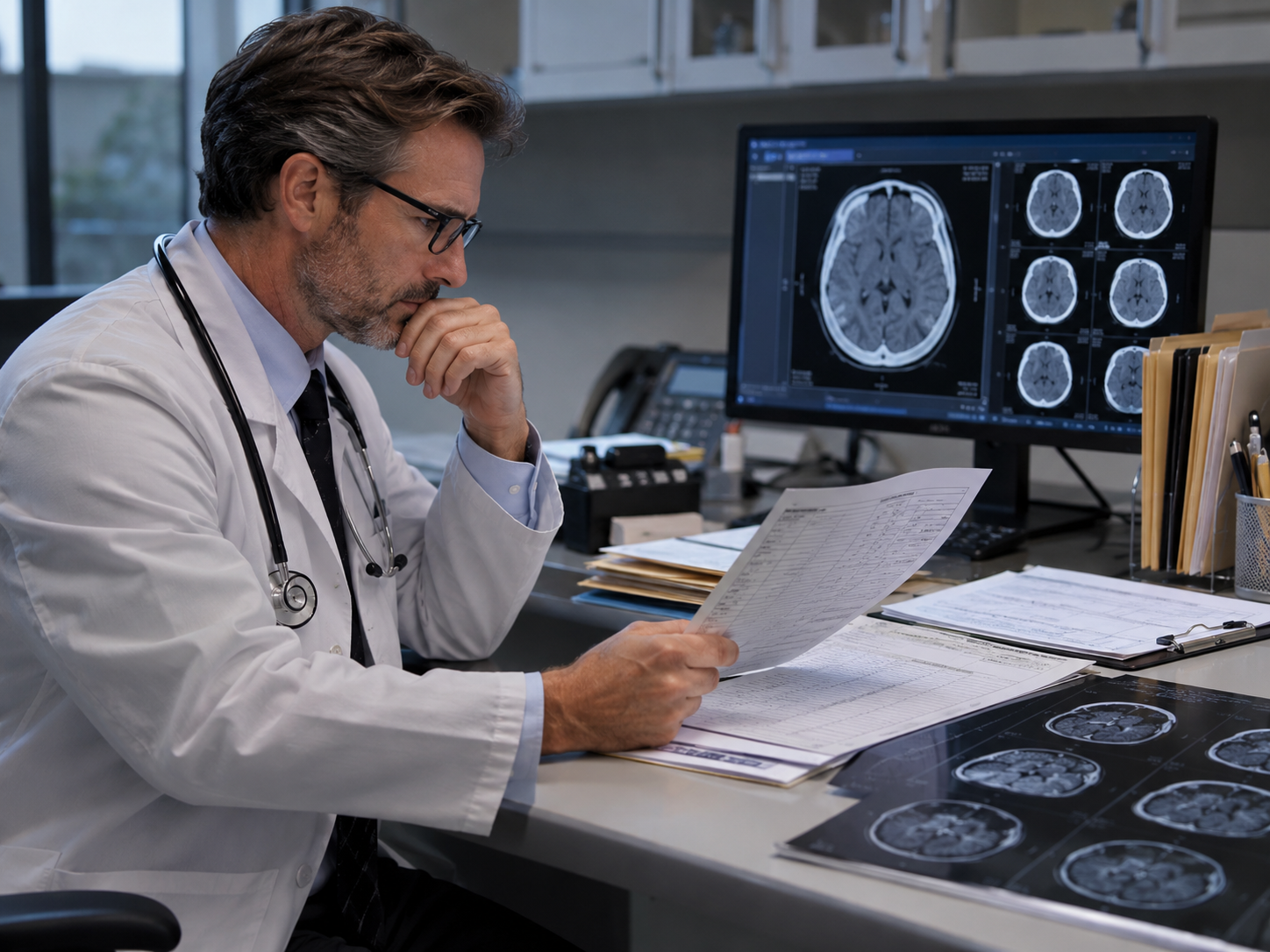
When a stroke occurs and is missed, the medical records from the visit often show a timeline. Some of the places that matter most:
Triage notes: the symptoms the patient described and when they started
Nursing notes and vital signs: changes in the patient's condition during the visit
Physician notes: the exam, including any check of strength, speech, vision, coordination, and walking
Scan orders and reports: which CT or MRI scans were ordered, when they were done, and what they showed
Consult notes: whether neurology was called, and when
Discharge papers: the diagnosis given and the instructions for when to return
Gaps between these entries, such as hours between a nurse's note about new weakness and a doctor's exam, are often some of the most important details in the chart.
Our attorneys have medical backgrounds, and reading records like these is at the heart of how we look at a case. We explain what we find in plain language.
When a Stroke Leads to a Loss
Some strokes are fatal, and losing a loved one after they were sent home from the emergency room can leave a family with painful questions. If you believe a misdiagnosis or delayed diagnosis played a role, your family may have legal options, including a possible wrongful death claim. You can learn more on our wrongful death page.
What You Can Do Now
Focus on recovery. Keep up with rehabilitation and follow-up care.
Write down the timeline. When did symptoms start? When did you arrive at the ER? What were you told, and by whom?
Keep your paperwork. Save discharge instructions, bills, and any messages from the hospital or insurers.
Request the records. Ask for the complete ER record and every scan from each visit.
Talk with a lawyer sooner rather than later. West Virginia has strict deadlines and special steps that apply before a medical malpractice lawsuit can be filed.
Talk With a Charleston Lawyer About a Missed Stroke
Tabor Lindsay & Associates, PLLC represents West Virginians in serious injury cases, especially medical negligence, birth injury, and wrongful death. We are doctor-lawyers. Our attorneys include Dr. Pamela Tabor Lindsay and Dr. Richard Lindsay.
If you are looking for a medical malpractice attorney in Charleston to help you understand whether a stroke was missed in the ER, call our office at (304) 344-5155 or request your free case evaluation online.
This article is general information and is not legal or medical advice. Reading it does not create an attorney-client relationship.

CONTACT US NOW
Questions?
Contact us today
Request a Free Case Evaluation!

CONTACT
We have the expertise to understand your case and win. Contact us for a free consultation.